Modern treadmills are essentially rolling computers with a motor attached. When something goes wrong, the console displays an error code to flag which system is struggling—speed control, incline, power delivery, communication, or the console itself.
If you’re seeing one of these codes and searching for a treadmill repair service, you’re not alone. Error codes are one of the most common reasons owners, property managers, and fitness facilities call for professional treadmill repair.
The tricky part is that treadmill error codes aren’t universal. An “E1” on one brand can mean something completely different on another. Still, there are common patterns across manufacturers, and in many cases, you can perform a few safe checks before deciding whether it’s a simple reset—or time to call a professional.
Below is a practical, brand-informed breakdown of the most common treadmill error codes, what they usually indicate, and which steps are reasonable for non-technicians.
First: Two Safe Steps That Solve Many Error Codes
1) Perform a Proper Power Cycle
A true power cycle clears temporary faults and forces the console and motor controller to fully reboot.
Stop the treadmill and step off
Turn the power switch OFF (usually near the front motor hood—follow the power cord)
Unplug the treadmill from the wall
Wait 60 seconds to allow internal components to fully discharge
Plug the treadmill back in and power it ON
Many manufacturers note that certain error codes will not clear until the treadmill has been fully powered down.
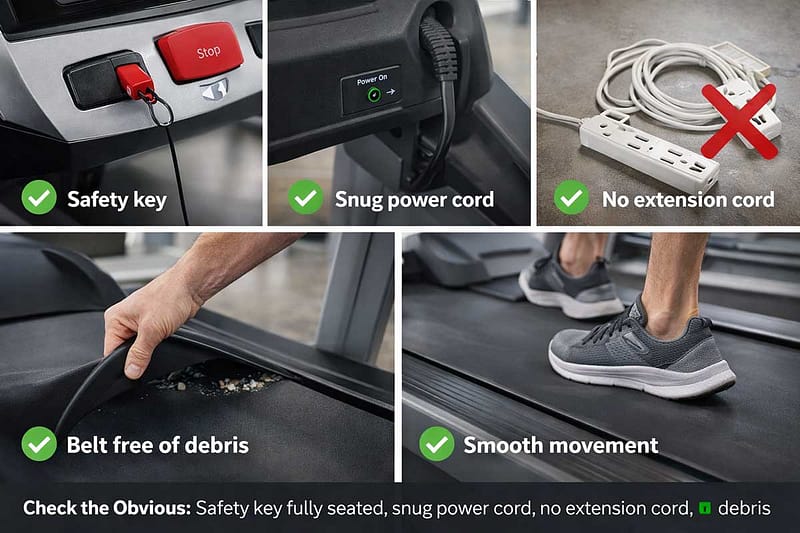
2) Check the Obvious (but Important) Items
These simple checks matter more than most people realize:
Safety key fully seated
Power cord secure at both the treadmill and the wall
No extension cord in use
No debris trapped between the walk belt and deck
No heavy resistance when moving the belt by hand (with power OFF)
If the treadmill immediately throws the same error code after a proper power cycle, the issue is usually more than a software glitch.
Common Treadmill Error Code Themes
Many consumer treadmills use short codes like E1, E2, or E3. While meanings vary by brand, the system affected is often similar.
E1: Speed Feedback or Belt Movement Error
What it usually means:
The treadmill is not detecting belt movement correctly, or the motor control system cannot maintain the commanded speed.
Common symptoms
Belt does not move after pressing Start
Belt starts, then stops
Speed fluctuates unexpectedly
Safe steps you can try
Perform a full power cycle
With power OFF, confirm the belt moves freely by foot
Run the treadmill’s built-in calibration if your model supports it
When to call a treadmill repair service
The belt repeatedly starts and stops
Speed surges or “hunts” up and down
You hear motor strain, smell burning, or feel belt slippage underfoot
These symptoms often point to speed sensor issues, excessive belt/deck friction, motor controller problems, or wiring faults.
E2: Erratic Speed or Console Memory Issues
E2 is one of the most brand-dependent error codes.
What it can indicate
Erratic or unstable speed control
Console memory loss or communication failure
Safe steps you can try
Power cycle the treadmill
Try a different wall outlet on a known-good circuit
Check visible console cables only if accessible without disassembly
When to call a technician
The error appears immediately on startup
The console resets, freezes, or loses settings
Speed becomes unpredictable during use
Erratic speed is a safety issue. If it happens more than once, stop using the treadmill until it is inspected.
E3: Incline or Elevation System Error
If your treadmill has incline, E3 often relates to lift motor movement or position feedback.
What it usually means
Incline was commanded, but movement or feedback was not detected
Elevation stalled or exceeded expected electrical load
In some cases, incline errors are triggered by excessive walk belt friction rather than a failed incline motor.
Safe steps you can try
Power cycle the treadmill
Check for physical obstructions under the unit
Run incline calibration if your manual allows it
When to call a technician
Incline motor hums but does not move
Incline is stuck fully raised or fully lowered
Incline errors occur repeatedly during normal use
Forcing incline movement can cause additional damage.
Numeric Error Codes on Commercial Treadmills
Commercial treadmills often use numeric error codes tied to specific subsystems.
Example: Precor Error 42
This code indicates the incline position value is outside the expected range, often due to calibration issues, wiring problems, or lift component failure.
Safe steps you can try
Power cycle the treadmill
Note the incline position when the error occurred
Run user-accessible incline calibration if supported
When to call a treadmill repair service
Incline appears physically stuck
Calibration fails or will not complete
The error returns at normal incline levels
Motor Overload or High-Current Error Codes
Some error codes indicate the drive motor is drawing too much current, commonly caused by:
Dry or worn walk belts
Excessive belt/deck friction
Improper belt tension or alignment
Safe steps you can try
Clean dust from the exterior motor area
Verify lubrication requirements for your treadmill model
Check for obvious belt misalignment
When to call a technician
The treadmill shuts down only when someone steps on it
You smell burning or see repeated overload errors
The belt feels sticky even after proper maintenance
When to Stop Troubleshooting and Call for Help
Contact a professional treadmill repair service if any of the following occur:
The treadmill surges, stalls, or accelerates unexpectedly
Circuit breakers trip repeatedly
You hear grinding, loud buzzing, or smell burning
Error codes return immediately after basic checks
Incline is jammed or speed will not hold under load
At this point, professional diagnostics can prevent further damage and ensure safe operation.
Frequently Asked Questions About Treadmill Error Codes
What does an E1 error code mean on a treadmill?
In most cases, an E1 error indicates a speed feedback problem. This means the treadmill is not detecting belt movement correctly or cannot maintain the selected speed. Start with a full power cycle. If the belt starts and stops repeatedly, professional treadmill repair is recommended.
What does an E2 error code usually indicate?
E2 errors are brand-dependent but often point to erratic speed control, console memory issues, or communication problems between the console and motor controller. If the error appears immediately after startup or the speed feels unstable, stop using the treadmill and have it inspected.
What does an E3 error mean on a treadmill?
E3 errors typically relate to the incline or elevation system. This may occur when the incline motor stalls, feedback is out of range, or the treadmill detects excessive electrical load. In some cases, high belt friction can trigger incline-related errors.
Can treadmill error codes be reset?
Some treadmill error codes can be cleared with a proper power cycle. Turn the unit off, unplug it, wait 60 seconds, then restart. If the error returns immediately, the issue is usually mechanical or electrical and will not resolve with resets alone.
Is it safe to keep using a treadmill with an error code?
No. If a treadmill displays an error code—especially one related to speed or incline—it should not be used. Continuing to run on a malfunctioning treadmill can increase the risk of injury and cause further damage to the equipment.
Why does my treadmill shut off only when I step on it?
This often indicates a motor overload or high-current condition, commonly caused by belt/deck friction, improper belt tension, or motor wear. This is a common reason users seek professional treadmill repair service.
Do treadmill error codes mean the motor is bad?
Not always. While some error codes involve the motor, many are caused by sensors, wiring, belt condition, incline systems, or control boards. Accurate diagnosis is important before replacing major components.